What’s Ahead with Stage 3 Meaningful Use

Meaningful Use (MU) Stage 3Stage 3 of the EHR Incentive Program (commonly known as “meaningful use”) starts on a voluntary basis in 2017 with a 90-day reporting period on eight objectives and their corresponding measures. Stage 3 requirements then become mandatory in 2018. The Centers for Medicare and Medicaid Services (CMS), which administers the program, says that achieving Stage 3 meaningful use will lead eligible providers and hospitals to a state of enhanced interoperability.

The objective areas of Stage 3 are:

  1. Protect electronic health information
  2. Electronic prescribing
  3. Clinical decision support
  4. Computerized provider order entry
  5. Patient electronic access to health information
  6. Coordination of care through patient engagement
  7. Health information exchange
  8. Public health reporting

Those last three measures signify “the heart and soul of what we think of as interoperability,” according to Robert Anthony, deputy director of the Quality Measurement and Value-Based Incentives Group at CMS.

The Stage 3 rules, although published in the Federal Register, are subject to a 60-day public comment period that expires Dec. 16. CMS will take comments into consideration before releasing the definitive version of Stage 3 sometime around the middle of 2016.

For now, we know that the care coordination objective requires a provider to send a secure message to 25 percent of all unique patients seen. The health information exchange objective focuses on sending a summary-of-care record electronically for more than 50 percent of transitions of care or referrals. And the public health reporting objective requires the provider or hospital to “actively engage” with a public health agency to submit data electronically for two measures such as immunizations and lab results.

Upon release of the Stage 3 rules, CMS said its intention was to emphasize measures that focus on interoperability instead of data entry. “We modified the measures so that more than 60 percent rely upon exchange of health information, compared to 33 percent previously,” the agency said in a Stage 3 fact sheet.

And since rules for 2015 Edition certified EHR technology were released in tandem with the Stage 3 meaningful use rules, developers of health IT products will have more than two years to work on new products that support program requirements. For instance, providers and hospitals can expect incorporation of application programming interfaces (APIs) into EHR technology to support patients’ access to health information — including via mobile devices. The 2015 Edition final rule also raises expectations for strengthened system security.

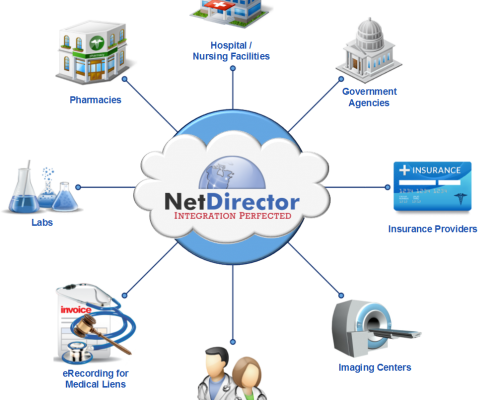
NetDirector, with its recently announced HealthData Exchange solution, already offers technology that meshes with the government’s framework for broad-reaching interoperability. Health Data Exchange enables secure, cloud-based data and document exchange between providers and vendors’ systems. As Stage 3 envisions, HealthData Exchange offers physicians’ and hospitals’ EHR systems a streamlined way to interoperate with other caregivers, radiology/imaging centers, immunization registries, labs, pharmacies, and even patient portals.

While we don’t yet have all the details of Stage 3 pending public comment, we do know that meaningful use will travel a path of heightened interoperability to reach the program’s final destination.

To learn how your organization can achieve interoperability faster with fewer in-house resources and lower set-up costs, request your free demo today.

Why Improved Interoperability Leads to Better Patient Care

Interoperability Leads to Better Patient CareOn October 6, 2015, the Department of Health and Human Services’ Office of the National Coordinator for Health Information Technology (ONC) released its Shared Nationwide Interoperability Roadmap. The 166-page document describes how public and private sector efforts will come together over the next 10 years to “advance the safe and secure exchange of electronic health information across the country to improve individual, community and population health,” according to ONC.
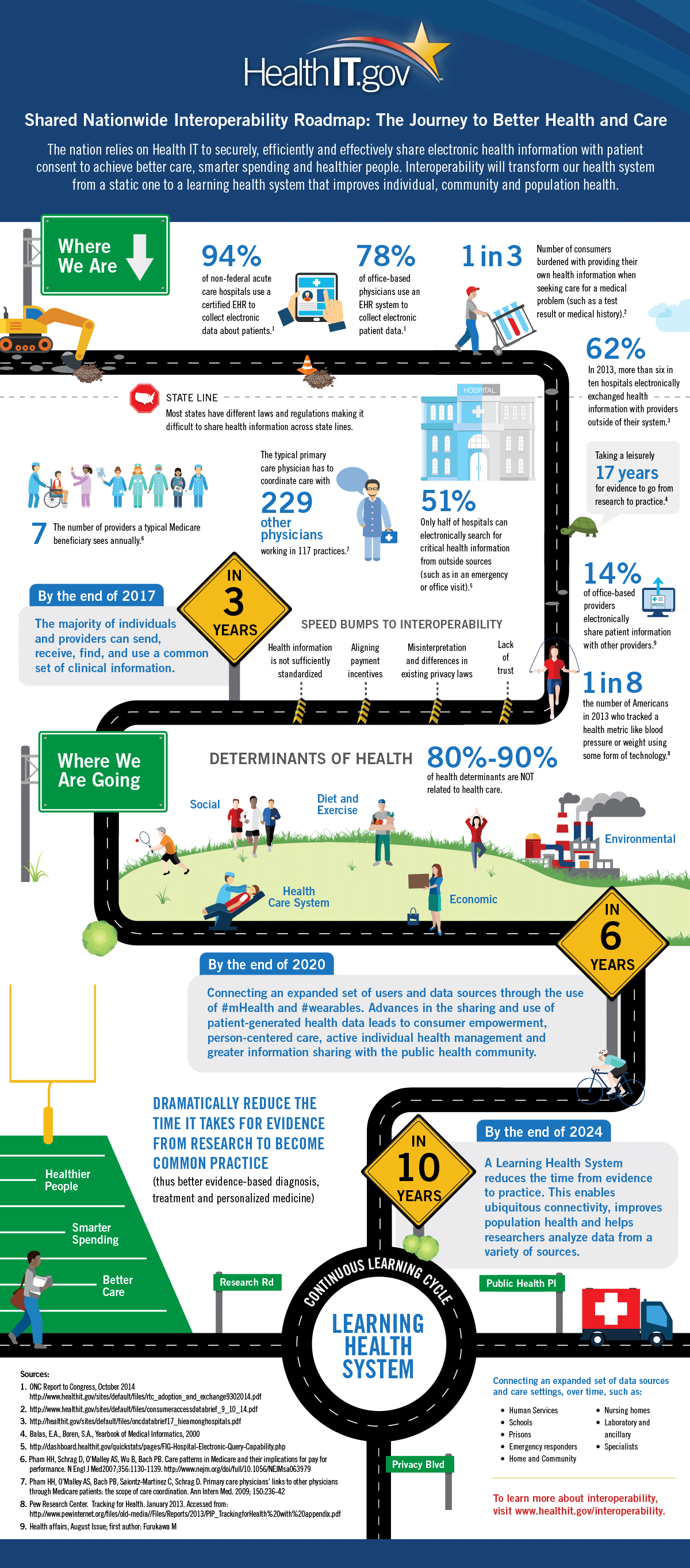
Near-term goals (2015-2017) focus on sending, receiving, finding and using a common set of clinical information to improve healthcare quality and outcomes. Data sources and users will expand via mobile health and wearable devices during the intermediate term (2018-2020) to support better health and drive down costs. Finally, in the long term (2021-2024), nationwide interoperability will become a reality with a person-centric system that leads to advances in public health and medical research through real-time data access.

Healthcare Interoperability, Interoperable Health IT EcosystemONC’s vision for a truly interoperable healthcare environment calls for enabling individuals to securely share electronic health information with care providers and make use of such information to support their own health and wellness through informed decision-making. In addition, “an interoperable health IT ecosystem should support critical public health functions, such as real-time case reporting, disease surveillance and disaster response, as well as data aggregation for research and value-based payment that rewards higher quality care, rather than a higher quantity of care,” the Roadmap states.

Nonetheless, work remains to be done in standardizing health information to enable interoperability across systems, aligning payment incentives intended to motivate adoption of health IT tools within value-based care models, and clarifying federal and state privacy and security requirements governing access to and use of protected health information.

In light of these potential obstacles, ONC’s Roadmap also emphasizes flexibility to allow for innovation on the part of technology developers. For example, NetDirector is helping to smooth the path toward interoperability with its new HealthData Exchange solution, which enables secure, cloud-based data and document exchange between healthcare providers and vendors. NetDirector announced the first such integration on November 17 in collaboration with Connect(x) Healthware. Any provider using the certified Chart (x) EHR now has an instant connection to NetDirector for sending/receiving numerous types of clinical or billing transactions.

Building on existing infrastructure will be a key principle guiding the establishment of an interoperable health IT ecosystem. Consider that 94 percent of non-federal acute care hospitals in the U.S. use a certified electronic health record (EHR) to collect data about patients, and 78 percent of office-based physicians use an EHR system to likewise collect electronic patient data.

The HealthData Exchange allows hospitals’ and physicians’ EHR systems to interoperate with other hospitals and physician groups, radiology/imaging centers, immunization registries, laboratories, pharmacies, and even patient portals. The cloud-based technology reduces the time, cost and effort required for EHR integration while streamlining clinical workflow and communications with the extended healthcare community needed to optimize patient care.

To learn how your organization can achieve interoperability faster with fewer in-house resources and lower set-up costs, request your free demo today.

NetDirector Receives the 2015 Best of Tampa Award

NetDirector: The Best of Tampa Information Technology 2015NetDirector Receives the 2015 Best of Tampa Award in the Information Technology Category for Exceptional Marketing Success

NetDirector, a leading provider of cloud-based data and document exchange services, has been selected for the 2015 Best of Tampa Award in the Information Technology Services category by the Tampa Award Program.

Each year, the Tampa Award Program identifies companies they believe have achieved exceptional marketing success in their local community and business category. These are local companies that enhance the positive image of small business through service to their customers and our community. These exceptional companies help make the Tampa area a great place to live, work and play.

Various sources of information were gathered and analyzed to choose the winners in each category. The 2015 Tampa Award Program focuses on quality, not quantity. Winners are determined based on the information gathered both internally by the Tampa Award Program and data provided by third parties.

About Tampa Award Program

The Tampa Award Program is an annual awards program honoring the achievements and accomplishments of local businesses throughout the Tampa area. Recognition is given to those companies that have shown the ability to use their best practices and implemented programs to generate competitive advantages and long-term value.

The Tampa Award Program was established to recognize the best of local businesses in our community. Our organization works exclusively with local business owners, trade groups, professional associations and other business advertising and marketing groups. Our mission is to recognize the small business community’s contributions to the U.S. economy.

About NetDirector

NetDirector provides a secure cloud-based data and document exchange solution for the healthcare and mortgage banking industries to deliver seamless interoperability between parties. NetDirector bridges gaps created by disparate systems & technologies by allowing companies at any location to share data & documents securely over a single internet connection with any other member of the ecosystem. Our approach can be re-used in any industry where trading partners need to collaborate and exchange data in a seamless bi-directional, real-time manner. NetDirector currently processes more than 7 million transactions per month.

Harry Beisswenger on Job Talk Radio St. Pete

Harry on Job Talk RadioRecently, Harry Beisswenger, CEO of NetDirector, was interviewed on a local online radio station, Radio St. Pete (Radioisotope.com).

Radio St. Pete is a 24 hour online and mobile radio station focused on the Tampa Bay area. Mr. Beisswenger sat down with Dean Logan, the host of Job Talk. Dean Logan interviews top local business leaders for ”Job Talk”, which, airs at the noon hour throughout the month and the shows are archived on the RadioStPete homepage.Continue reading

HealthIT Interoperability Solution for Healthcare Providers

Health IT InteroperabilityInteroperability has been a hot topic across the healthcare industry for some time now, especially with Meaningful Use Stages 1 – 3 which launched in 2011. CEOs, CIOs, CTOs among others have all been discussing and searching for the right solution to the Interoperability challenges facing the Health IT industry today and to meet the deadlines for the Meaningful Use stages.

Here are what some of the most prominent leaders in Health IT are looking for to meet Meaningful Use Stage 2 requirements…

  1. HIPAA Security
  2. Interoperability between disparate systems
  3. Use data to provide meaningful information that can be used to make clinical decision

Continue reading

Securing NetDirector’s Cloud-Based Data Exchange

What does security mean to you?CloudSecurity

For each of us it means something different depending on what we want to secure. For some it may mean setting up a home alarm system to protect the family, locking the car doors to secure valuables, or saving enough money to secure one’s livelihood for 6 months in case of a layoff or medical emergency.

Whatever you are trying to secure it is important to have a high quality security system in place with a proven track record to prevent intrusions.

Due to the overwhelming increase in vulnerability of the small to mid-size businesses, our goal at NetDirector is to secure our data exchange software so that our customers and service providers are confident their valuable data is safe and secure.

How does NetDirector secure the data exchange software?

Continue reading

Welcome to NetDirector’s Default Servicing and Healthcare Blog

Welcome to our new blog!blog-world

NetDirector has been committed to providing top notch customer service and we believe our blog will be another opportunity for us to reach our customers, servicers, partners, and prospects, while keeping them up-to-date on the latest industry news, software updates, company news, and community involvement. Please take a moment to save our blog and RSS feed.

Continue reading